TABLE AGREEMENT EXECUTIVE SUMMARY
The purpose of this executive summary is to highlight features of the Table Agreement (TA) impacting a significant percentage of PG&E employed members. There are many details in the TA not included in this summary, please refer to the Physical TA full text or the Clerical TA full text for more detail.
Term: 3-year term, January 1, 2026- December 31, 2028
General Wages Increases (GWI): 2026: 5.0% (effective 1/1), 2027: 5.0%, 2028: 5.0% (highest in more than 40 years.)
Classification Wage Adjustments: The Bargaining Committee secured wage adjustments for many classifications to address issues such as wage compression, recruitment, retention, changes to job duties, and the creation of new classifications. These one-time wage adjustments are in addition to the 2026 GWI.
Meals: All “in lieu” meals will be paid at $50, up from $20 for dinner meals. 85% of all meals are taken as “in lieu”. All OT meals taken will be paid $50 regardless of cost, no receipt required. All time taken for meal consumption will be paid, however, only up to one hour will be counted toward a rest period.
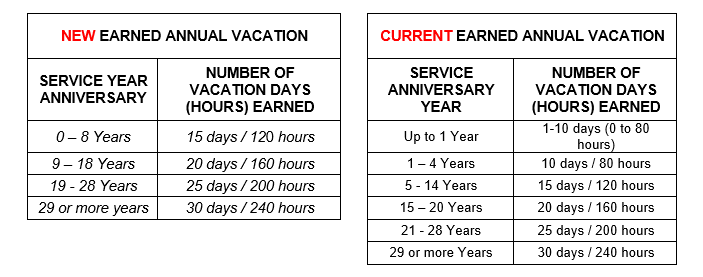
Vacation: In exchange for more vacation during a member’s career, the TA moves the 2x annual vacation cap to a “use it or stop accruing model”. In cases where a member reaches 2x their annual vacation allotment without attempting to schedule and use their vacation prior to reaching the cap, they will stop accruing until they are below the cap.
Bereavement Leave: Increased from 3 days to 5 days.
Leaves of Absence and Sick Leave: Updated language to conform to Federal, State and Local laws including expanded criteria for use of sick leave and to clearly document current practices for all members at PG&E.
Active Medical: The member medical plan premium contribution for most plans is changing from 7.5% to 10%, still significantly below what members pay at some other major utilities such as Southern Cal Edison (20% contribution), San Diego Gas & Electric (20% contribution), and SMUD (12.5% contribution.) The committee negotiated the addition of a Health Savings Account (HSA) qualified High Deductible Health Plan with a 7.5% plan premium contribution and an annual HSA contribution by PG&E. Without this modest premium contribution increase, the amount of General Wage Increase realized in this negotiation would have been significantly lower. Part-time employees will also have a 10% premium cost share, resulting in significant cost savings for our part-time members.
Retiree Medical: Retiree Medical will change from a plan provider model to a Retiree Healthcare Reimbursement Arrangement (RHRA) account model. PG&E will fund RHRA accounts of participating retirees as follows: $15,000/year/participant for pre-Medicare retirees and $1,800/year/participant for Medicare eligible retirees. This means, for a pre-Medicare retiree with a plan eligible pre-Medicare spouse, the RHRA account funding amount would be $30,000/year. These reimbursement amounts will automatically increase by 3% each year. Upon retirement, any funds in an active employee HRA account will be transferred into their RHRA account. Any RHRA funds not spent on medical plan premiums can accumulate and be used for any IRS eligible healthcare expense including some dental and vision expenses. To participate in the RHRA, retirees will have to purchase medical coverage through a PG&E selected broker.
Clerical: The company sought major concessions from clerical, arguing clerical wages are currently way above the market rate. Placing a premium on job security, the committee successfully blocked their attempt to include “contracting out” language. We rejected efforts to adopt a 2-tier wage system that would have lowered the starting and ending wages for all future clerical. We rejected the offer of a “lump sum” instead of a GWI, (GWI is pensionable and compounds) and preserved the current time frame for wage progression at 54 months rather than the 84-months the company sought. All Senior Operating Clerks will be placed at the same wage rate as Senior Operating Clerk II, which is a higher rate
AI and Tech Changes Guardrails for Physical and Clerical Contracts: The Bargaining Committee secured new language in both the Physical and Clerical agreements requiring the Company to notify the Union prior to implementing any new technology or tool having a material impact on work normally performed by IBEW 1245 bargaining unit members. The agreement language also requires the Company and Union to bargain in good faith over the effects of its decision to use or implement new tools or technology. The requirements apply to the use or integration of Artificial Intelligence, Autonomous At-Scale Data Collection Systems, Autonomous Systems, Autonomous Technologies, Drones, Autonomous Vehicles, AI operated systems, Robotics, or any other similar technologies.
GC Per Diem Increases & digitalized TP Sheet: The digitalized TP sheet is currently being piloted at Station Substation, Hydro Construction, and GC Construction.
New per diem rates:
- more than 25 but 45 or less: $30, old amount $11
- more than 45 but 65 or less: $50, old amount $20
- more than 65: $75, old amount $30
Service Employee’s Residency Requirements: The TA requires Service employees (GSRs, Troubleshooters, Switching Electricians) to live either:
- 30 miles from the headquarters or
- within their service territory and no more than 50 miles from their residence to their headquarters.
New 24/8 Fatigue Policy: The Company and Union agreed to new fatigue/employee replacement language. The language allows the Company to replace an employee who has worked for twenty-four (24) consecutive hours and requires them to have an eight (8) hour break before resuming work. During the eight (8) hour break, the employee will not be eligible for overtime callout. If the employee is replaced, they will not be compensated for the time worked by their replacement. If the employee is required to return to work during the eight (8) hour period, they will receive two times the straight rate of pay for all hours worked until they are released. Arb-120 still applies for replacement penalty outside of these new criteria (an employee replaced before working twenty-four (24) consecutive hours).
New Standby Pilot for Response Time: The parties have agreed to a structure that enables local headquarters to pilot dedicated emergency response (standby) via local letter of agreement. The local pilot agreements will establish the classifications and departments to be included, the standby schedule, and standby expectations. Employees providing standby coverage will receive $20/hour, or the applicable minimum wage for the area, whichever is greater, for all hours the employee remains on emergency standby. If an employee on standby is called to respond during the emergency standby period, the employee will be paid in accordance with applicable provisions of the Physical Agreement.