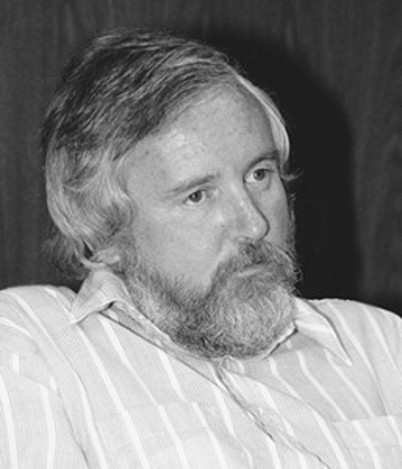
McNally believed that political action was an essential weapon in the union’s arsenal.
IBEW 1245 mourns the passing of former Business Manager Jack McNally, who passed away over the weekend at the age of 88.
McNally served as Business Manager of IBEW 1245 from 1980 to 2001, leading the union through more than two decades of significant growth, challenges and change. McNally was a dedicated advocate for working people who helped shape 1245 into the influential labor organization it is today.
“Jack was a powerful force at 1245, IBEW and the labor movement at large,” said Bob Dean, IBEW 1245 Business Manager. “For 21 years, he led this union through some very challenging times, always focused on protecting our members and their livelihoods. He made a lasting difference, and the union is stronger today because of his leadership.”
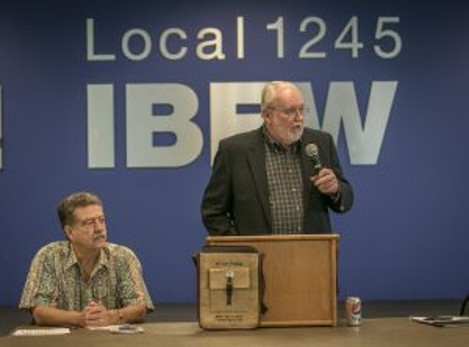
McNally speaking to the IBEW 1245 Advisory Council in January 2017.
Jack is survived by his wife, Eve, two daughters, a stepson and his grandchildren. “The entire IBEW 1245 family extends its heartfelt condolences to Eve, Jack’s family and friends, and all who had the privilege of knowing and working with him,” added Dean.
McNally was initiated into the IBEW in 1960, beginning a lifelong commitment to the union and its members. As a lineman at PG&E, he helped organize ditch tenders at the Merced Irrigation District in 1965. He joined the union staff as a Business Representative in 1968, became Assistant Business Manager in 1976 and was elected Business Manager in 1980.
Over the next 21 years, McNally guided the union through a period of extraordinary transformation in the utility industry.
Among the significant events during his leadership was the 1992 Asplundh tree trimmers strike, which resulted in an important victory for Local 1245 members. But one of the greatest tests of McNally’s leadership came during California’s move toward electric deregulation in the 1990s.
In 1994, the California Public Utilities Commission announced plans to deregulate the electric industry, promising greater customer choice and lower rates.

As the utility industry underwent sweeping changes, longstanding assumptions about job security were suddenly called into question. PG&E began restructuring its operations, and in late 1994 and early 1995, approximately 2,800 employees received layoff notices. It was a shock to members.
PG&E had long offered stable careers and a family-like atmosphere, with employees gathering for barbecues at company yards. The threat of mass layoffs shattered that sense of security and forever changed the workplace culture.
Assistant Business Manager Hunter Stern, a longtime 1245 staff member whom McNally hired in 1994, recalled that many members struggled to understand how their jobs could be threatened when the company still had so much work to do.
McNally, however, recognized the company could continue performing the work without employing the same union workforce. Contracting out presented a serious threat to members’ livelihoods, and McNally understood that the union needed to act.
The union organized informational picketing at PG&E facilities throughout the state, challenged the company’s claims about its operations and infrastructure, and took its concerns directly to regulators, elected officials and the public.
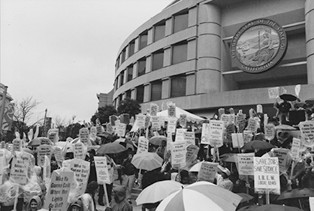
Nearly 1,000 IBEW members and friends turned out in pouring rain at the CPUC in San Francisco to protest downsizing in 1994. IBEW 1245 Archive photo by David Bacon
In December 1994, McNally organized a major demonstration at the California Public Utilities Commission in San Francisco. Despite pouring rain, nearly 1,000 union members and supporters rallied against downsizing and the threat it posed to workers and the communities they served. Their rallying cry: “Who ya gonna call when the lights go out?”
The union also lobbied local elected officials and brought attention to deteriorating infrastructure, including power poles that needed replacement.
Then came the storms. In January 1995, severe weather caused prolonged power outages affecting approximately 1.4 million customers. More storms followed in March, with IBEW 1245 members working long hours to restore power even as their own jobs remained on the line.
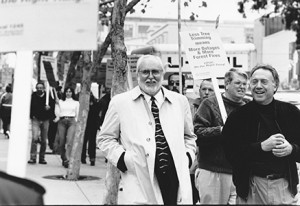
Business Manager Jack McNally, left, and IBEW Legislative Advocate Art Carter picket in 1999, urging the CPUC to protect service reliability. IBEW 1245 Archive photo by David Bacon
IBEW 1245 pressed regulators to investigate PG&E’s performance and continued making the case that reducing the workforce would undermine the company’s ability to maintain a safe and reliable electrical system.
On April 5, 1995, PG&E announced that it agreed with the union’s analysis and canceled the layoffs.
The victory brought lasting protections. Under McNally’s leadership, the union negotiated stronger job security provisions, including restrictions on contracting out and requirements the company had to meet before laying off employees.
The union also negotiated stronger infrastructure inspection and repair programs at PG&E. In 1997, IBEW 1245 helped secure General Order 165 through the California Public Utilities Commission, establishing inspection requirements for investor-owned electric utilities throughout the state.
McNally helped establish and lead the Coalition of California Utility Workers, bringing together approximately 150,000 utility workers to protect wages, benefits and other negotiated protections from regulatory interference.
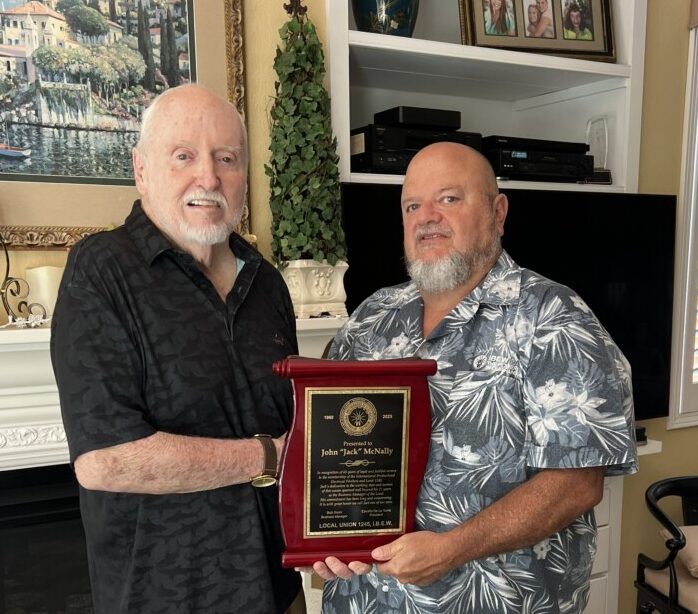
Pictured with IBEW 1245 Business Manager Bob Dean, John “Jack” McNally was honored in 2025 for 65 years of loyal and faithful service to the IBEW and Local 1245. His dedication to the union and its members extended far beyond his 21 years as Business Manager, reflecting a lifetime of unwavering commitment to working men and women.
“Jack was a very effective political leader, both within the IBEW and in Sacramento,” recalled Stern. “He understood the importance of building relationships with elected officials and making sure working people had a voice in the decisions that affected them.”
He also recognized that the changing utility industry required new approaches and perspectives within IBEW 1245. McNally recruited staff members from outside the union’s traditional ranks, including individuals with experience in other labor organizations and people with backgrounds outside the utility trades.
Protecting clerical jobs was another big fight. As PG&E moved away from local customer service counters and consolidated those operations into centralized call centers, 1245 negotiated to keep those jobs in California and preserve the protections and standards established under its clerical agreement.
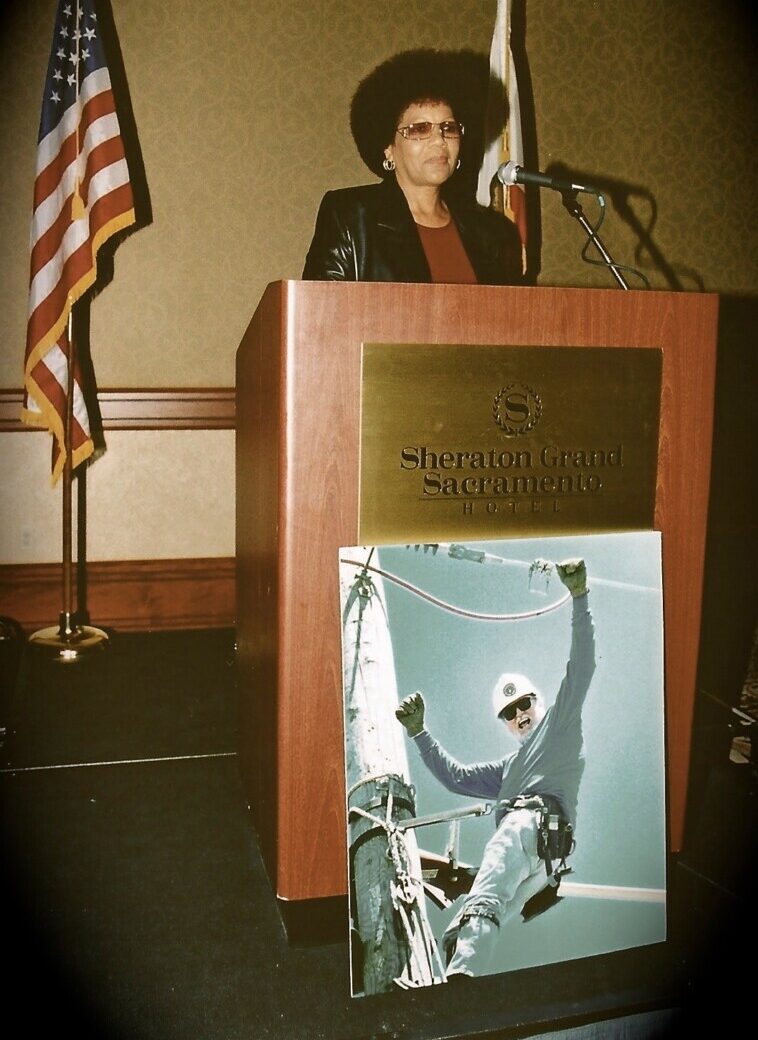
Former Assistant Business Manager Dorothy Fortier speaks at an event. Displayed at the podium is a photo of Jack McNally atop a utility pole during his years as a lineman.
Former Assistant Business Manager Dorothy Fortier, who participated in those negotiations during McNally’s administration, emphasized that the protections members benefit from today were always hard-won.
“We wouldn’t have the protections and benefits we have today if it weren’t for our union,” Fortier said. “The company has never just given us anything.”
Workplace safety was another priority throughout McNally’s leadership.
Early in his tenure, the union successfully challenged the suspensions of six members who had refused to clean up oil containing dangerous PCBs.
When California’s occupational safety program was eliminated in 1987, McNally and IBEW 1245 played an important role in the successful campaign to restore Cal/OSHA. The union’s Executive Board authorized an unprecedented $200,000 contribution to the effort, underscoring its commitment to protecting workers on the job.
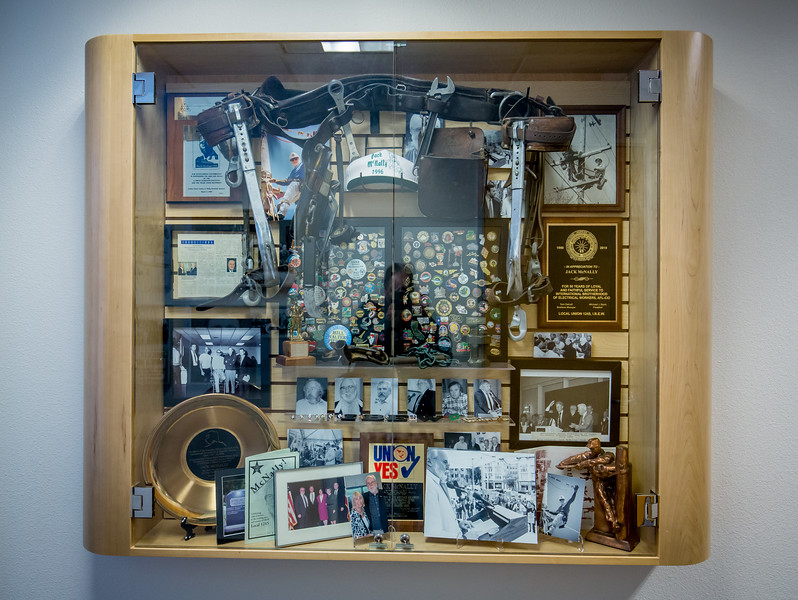
To commemorate McNally’s numerous contributions to the union, Local 1245 unveiled a showcase at Weakley Hall, featuring a wealth of union memorabilia from McNally’s tenure, including photos, pins, plaques and awards.
McNally’s influence extended well beyond IBEW 1245. Fortier remembered him as a people person and a skilled coalition builder, capable of bringing together union leaders representing different trades and sometimes competing interests.
That ability helped McNally rise to chairman of the IBEW International Executive Council, a position requiring support from across the Brotherhood.
“For him to become the IEC chair was a big move,” Fortier recalled, noting McNally’s ability to bring together leaders from across the IBEW’s various branches, each with its own perspectives and priorities.
In 2000, McNally was elected to the board of directors of the Federal Reserve Bank of San Francisco, bringing the perspective of organized labor to an institution with significant influence over the nation’s economy.
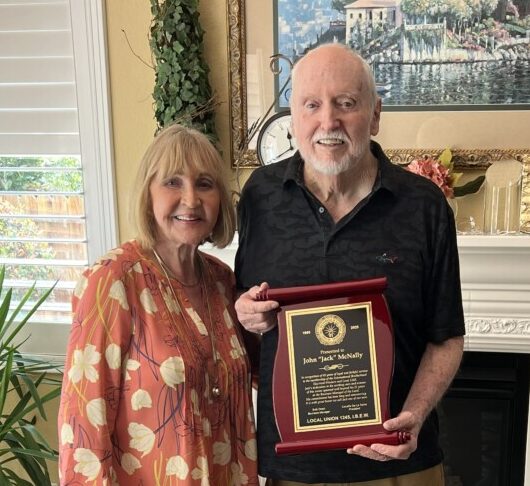
Jack and his wife, Eve as he is presented with a lifetime of service award from IBEW Local 1245.
Jack McNally dedicated much of his life to improving the lives of working people. The union he helped build, the jobs he fought to protect and the generations of workers who benefited from his leadership stand as a testament to his life’s work.
Rest in peace, Brother McNally.