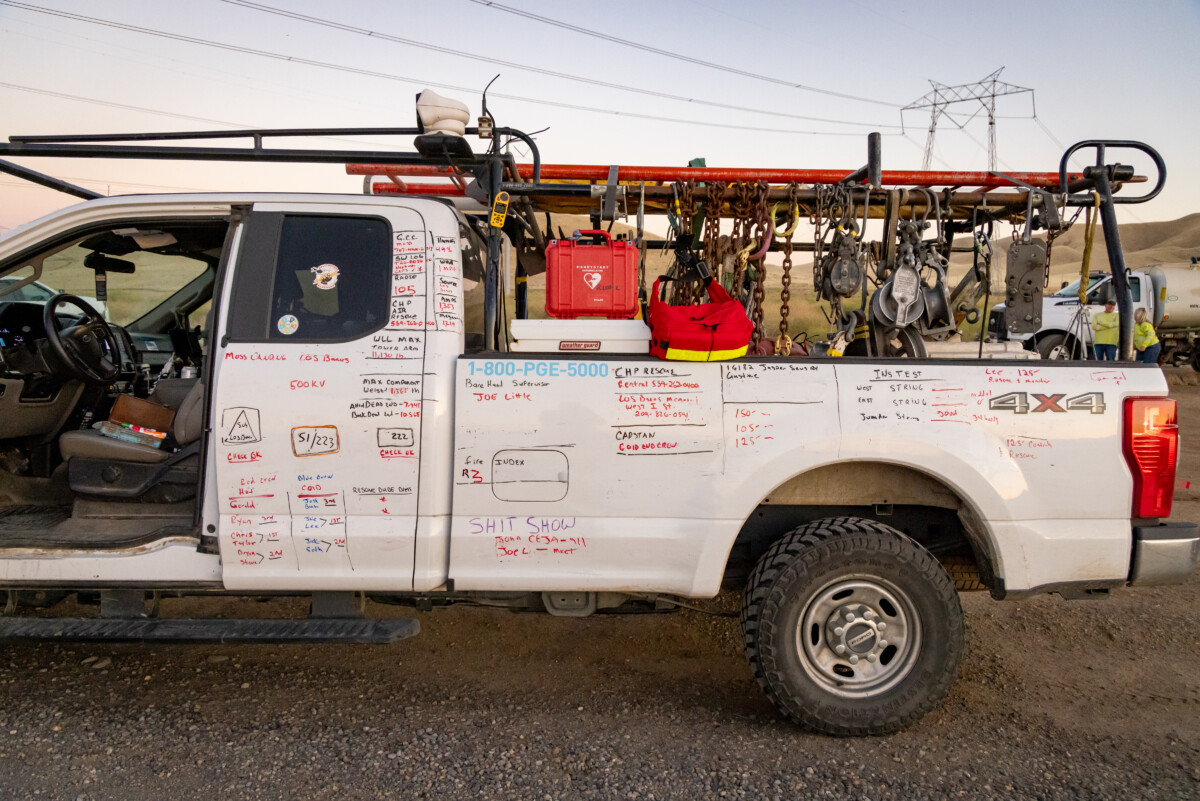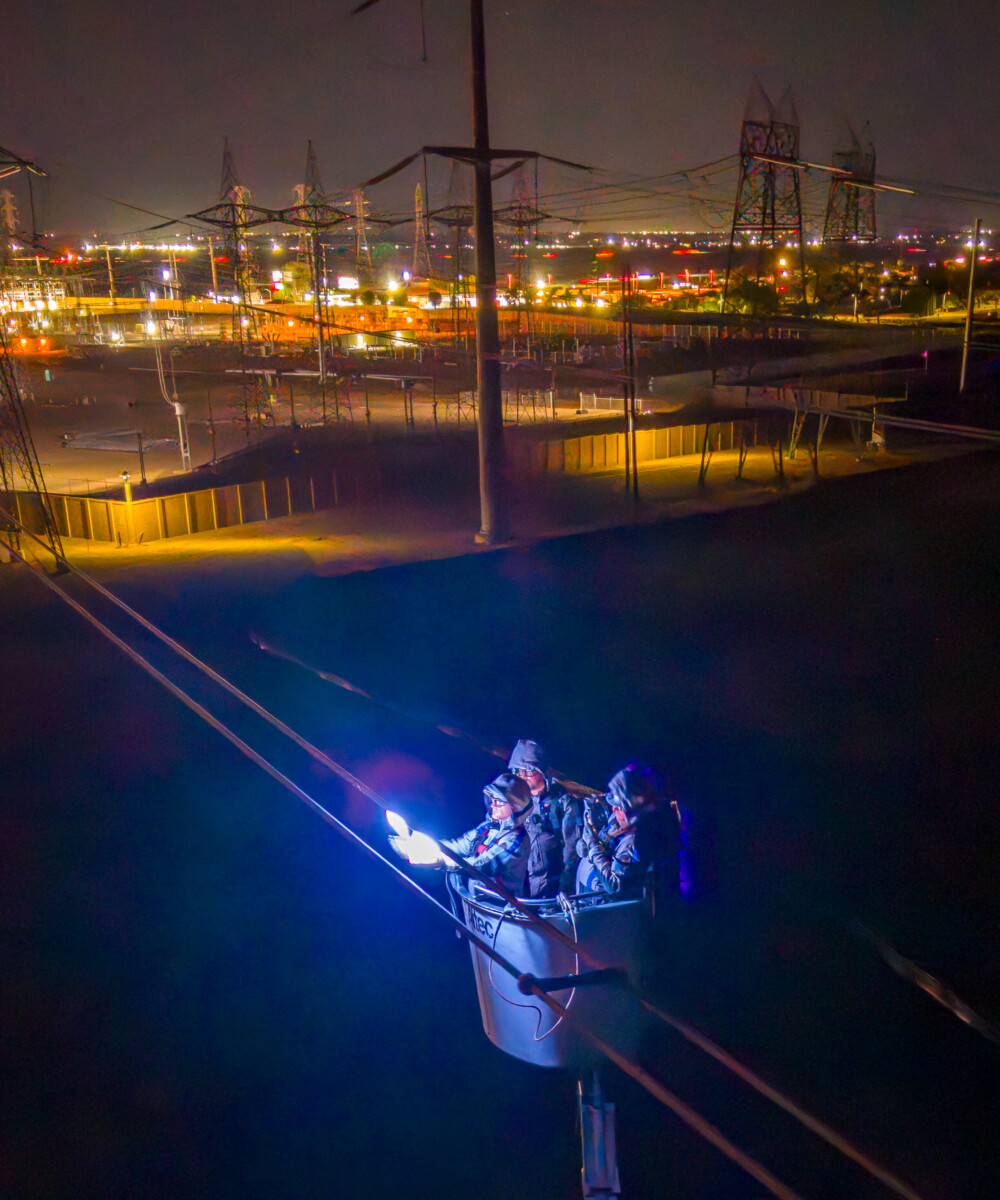
IBEW Local 1245 linemen from PG&E take bare hand training in Gustine, Calif. on June 9, 2026.
The sound gets everyone’s attention.
For most linemen, the crackling, buzzing, and arcing associated with high voltage is a warning sign. It’s a signal that something is very wrong.
In barehand training, linemen learn to lean into it.
“Usually if you hear that sound, you’re stopping what you’re doing and trying to figure out what’s wrong,” said Transmission Lineman Taylor Gillespie. “Out here, that arcing is happening all around you.”
Learning to become comfortable around the very thing they’ve been trained to avoid is one of the many challenges facing participants in PG&E’s Barehand Certification Training Program.
Over the course of three weeks in May and June, transmission linemen from across PG&E’s system trained to perform one of the most specialized tasks in the utility industry. Barehanding is a method in which linemen bond directly to energized 500-kV transmission lines, allowing critical maintenance to be performed without taking facilities out of service.
The class marks the return of PG&E’s barehand training program, which was suspended in 2019 following a flashover incident. After a third-party safety assessment and a review of industry best practices, PG&E and IBEW 1245 implemented updated procedures and enhanced safety controls, paving the way for a six-month pilot program.
For Ryan Skelton, who is a member of the Barehand Working Committee and a IBEW 1245 Business Representative and longtime lineman, the opportunity carried special significance.
“Throughout my career, I’ve been fortunate to represent both the Union and the Company at many events, including the Kansas City Lineman Rodeo,” said Skelton. “I’ve had some incredible experiences along the way, but being part of this Barehand class ranks at the very top. In the lineman world, barehand work is truly the tip of the spear. For many of us, it’s a bucket-list accomplishment and something I’ve admired and respected throughout my career.”
Over three weeks, the group of linemen from across PG&E’s service territory also began to come together as a crew.
“A lot of us had never worked together before,” Skelton said. “We’ve got guys from all over the system. But by the end, everyone’s joking around and giving each other a hard time like a normal crew.”
The work requires extensive preparation and a level of focus developed through repetition and training. Linemen wear specialized conductive garments known as Faraday suits, designed to bring them to the same electrical potential as the energized line.
“The new suits mean you don’t really feel much, maybe a little tingle around your face. But you can hear the electricity, and that’s the crazy part,” said Bryan Salo, a Transmission Crew Foreman from Sacramento’s T-Line Yard.
Despite the unique environment, Salo said the training builds upon skills linemen already possess.
“The training’s been great,” he said. “It’s all line work, but there are different procedures and modules, and the instructors have laid everything out really well for us.”
The Utility Reporter visited during the class’s “Night Bond,” a long-standing tradition of the training program. Conducted during the final week, the nighttime exercise allows participants to demonstrate their skills when the electrical effects become visible in the darkness.
The following morning, the training shifted from demonstration to application.
Working from insulated aerial platforms and helicopters, trainees performed maintenance on energized transmission lines, replacing conductor spacers, vibration dampers, and repair clamps on bundled conductors.
To safely perform the work, linemen first bond themselves and their equipment to the energized conductor, bringing the bucket, suit, tools, and worker to the same electrical potential as the line itself. Once that connection is established, they can physically touch the conductor and begin work.
The concept is similar to a bird sitting on a power line. Because the bird is at the same electrical potential as the conductor and isn’t creating a path to ground, electricity continues flowing through the line rather than through the bird.
From the ground, the process appears almost unbelievable.
Even the helicopter crews supporting the work must adapt their procedures.
“The energized work requires a different approach,” said Greg Freed, a helicopter pilot with A&P Helicopters. “We’re used to bringing crews straight down, but around energized equipment we have to approach from the side and be careful not to get too close to the insulator strings.”
The origins of barehand work date back to the 1960s, when engineers first developed methods that allowed linemen to safely work directly on energized transmission facilities. PG&E adopted the practice in the early 1990s.
The work can only be performed under carefully controlled conditions. Weather, humidity, atmospheric conditions, equipment cleanliness, and countless other variables must all be evaluated before a crew ever leaves the ground.
The program’s return carries special significance for many of those involved, including Matt Taylor, a Bakersfield Transmission Troubleman, member of PG&E’s Barehand Committee, and second-generation barehander.
“We were the first in California to do this work, and we used to be the leading experts,” Taylor said. “With the group we’ve got now, I have no doubt we can take that legacy even further than before.”
The return of PG&E’s Barehand Program was the result of years of dedication from Company and Union leaders, committee members, instructors, and subject matter experts committed to bringing the program back safely and successfully.
Special recognition goes to Joe Little, Pete Dominguez, Bob Gerstle, Casey Barker, and the many other members of the Barehand Committee who invested countless hours developing procedures, evaluating industry best practices, and building the framework that made the program’s return possible after a seven-year absence.
Their efforts have not only restored a proud tradition at PG&E but have also positioned the program for long-term success through the leadership and expertise of PG&E’s four full-time Barehand Specialists — KC Nancolas, Travis Doyle, Jared Merkle, and Mark Stacy.
For the 12 graduates, certification represents more than a new skill. It marks the beginning of a new chapter for PG&E Barehanding and the continuation of a tradition that had been absent from the company for seven years.
Even after completing the training, Ryan Skelton admitted that hearing the crackling and buzzing of high voltage still feels counterintuitive.
“It’s so wrong, it’s right,” Skelton said with a laugh.
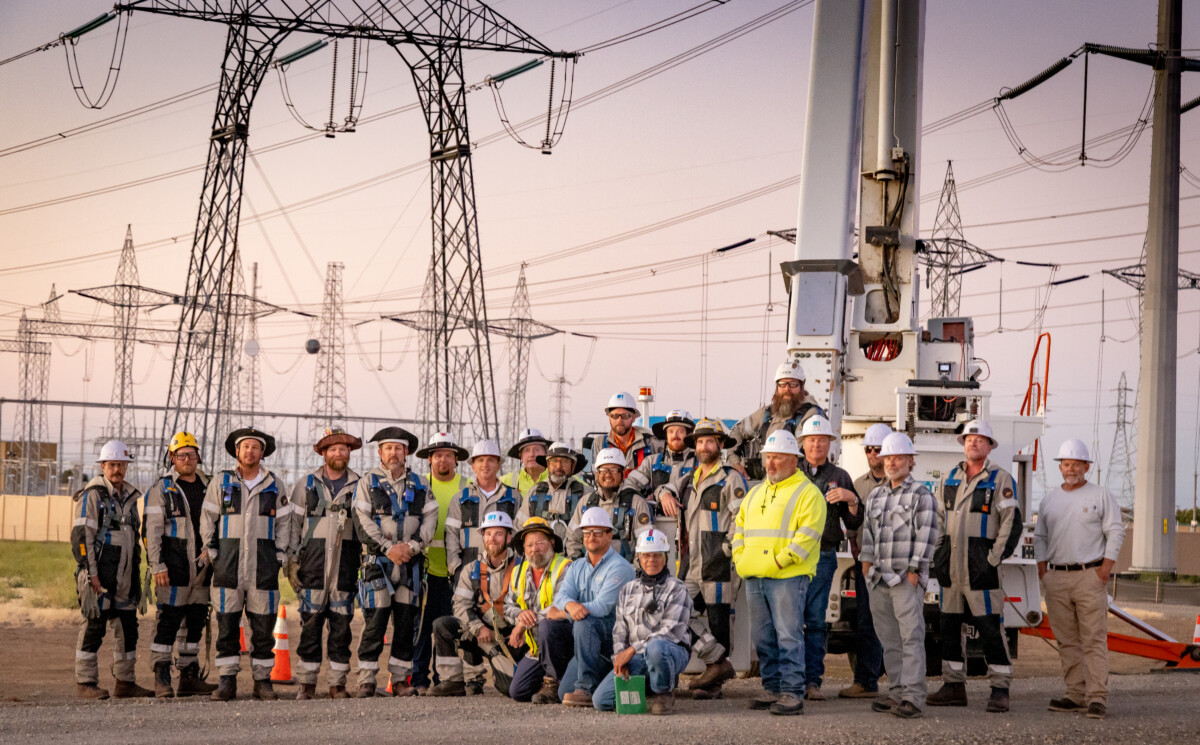
IBEW Local 1245 linemen from PG&E take bare hand training in Gustine, Calif. on June 9, 2026.